It doesn’t take a catastrophic incident to understand what’s at stake in facility management. A single system failure can halt operations and trigger financial, operational, and reputational costs. At the same time, the pressure to deliver tangible outcomes is increasing.
While 56% of facility teams expect work order volumes to rise, more than 42% say they’re already understaffed. Expectations around uptime and performance are non-negotiable, even as available resources tighten.
Facility managers need clear strategies to help them do more with less. These strategies should focus on what teams can do immediately to reduce risk, strengthen system awareness, and maintain control in environments where failure isn’t an option.
What is Facility Management?
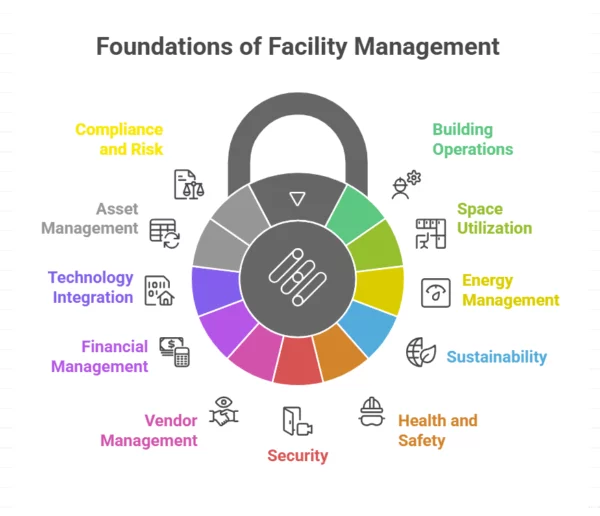
Facility management (FM) coordinates people, processes, and technologies to ensure the effective, safe, and sustainable operation of buildings and their systems. It is crucial for organizations that depend on complex infrastructure, such as data centers, commercial complexes, and industrial facilities. The role of a facility manager often spans many domains, including:
- Building Operations and Maintenance: Facility maintenance management ensures the functionality and longevity of mechanical, electrical, and water systems.
- Space Utilization Planning and Management: Allocating and optimizing physical spaces to support organizational goals and accommodate varying needs.
- Energy and Water Management: Monitoring and controlling utility consumption to reduce costs, comply with regulatory standards, and support ESG commitments.
- Sustainability and ESG Compliance: Aligning facility operations with ESG goals according to local facility management best practices and global standards.
- Health and Safety: Maintaining safe working environments by complying with regulations, conducting risk assessments, and implementing preventive measures.
- Security and Access Control: Protecting physical and digital assets from unauthorized access through access control, surveillance systems, and incident response protocols for physical and cyber breaches.
- Vendor and Contract Management: Maintaining a relationship with third-party service providers to ensure service quality, cost-effectiveness, and alignment with service level agreements (SLAs).
- Financial Management and Budgeting: Planning and managing operational budgets, forecasting maintenance costs, justifying capital investments, and communicating them to the C-suite.
- Technology and Smart Building Systems: Integrating digital platforms and connected devices to monitor performance, automate tasks, and generate actionable insights across building systems.
- Asset Management and Lifecycle Planning: Implementing a validation plan to assess performance against operational requirements, justify replacements or upgrades, and ensure capital investments are timed appropriately.
- Compliance and Risk Management: Meeting regulatory obligations while minimizing exposure to operational and financial risks.
The Business Impact of Effective Facility Management Best Practices
Even minor issues in a facility can quickly escalate into significant and costly disruptions. That’s why refining your facility management strategy isn’t just good practice; it’s essential. The most forward-looking teams are doing it to gain advantages such as:
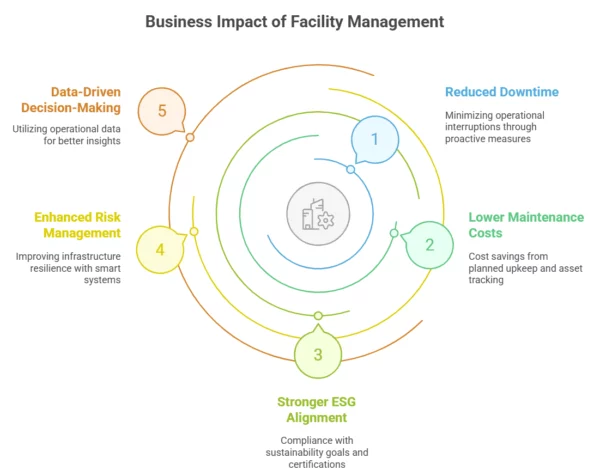
1. Reduced Downtime
More than half (53%) of facility managers rank minimizing downtime as their top priority in their work. Many failures interrupting operations are preventable and can be reduced with proactive maintenance, real-time monitoring, and mitigation.
2. Lower Maintenance Costs
Dealing with emergencies and unplanned outages is always more expensive than planned upkeep activities. Facility management best practices like proactive maintenance and asset lifecycle tracking make it much easier for facility management teams to catch minor malfunctions before they become costly outages.
3. Stronger Alignment with ESG Goals
Facility managers are demanded and expected to be sustainable. Mature and effective FM practices are environmentally friendly and aid in complying with regulatory demands, earning relevant certifications like BREAM and LEED, and showing investors the ROI of sustainability over time.
4. Enhanced Critical Infrastructure Risk Management
Overlooked risks like faulty equipment or slow leaks can threaten entire operations. Strengthening infrastructure resilience means having clear protocols supported by smart sensors, response plans, and systems that give teams full visibility and control, even in high-pressure scenarios.
5. Delivering ROI Through Data-Driven Decision-Making
Facility management systems in modern buildings generate a wealth of operational data that can be turned into actionable insights. Almost all (97%) facility managers who employ asset management software to make data-driven decisions say that the top benefit is better decision-making.
7 Facility Management Best Practices You Can Start Today
1. Embrace Predictive Maintenance
Predictive (or preventative) maintenance uses accurate data to identify signs of wear or inefficiency before failure happens. According to the US Department of Energy, adopting a comprehensive predictive maintenance program can reduce maintenance cost by 25% to 30% and eliminate breakdowns by 70% to 75%.
If you’re looking for quick wins with predictive maintenance, start with your water systems. Leaks, pressure irregularities, and undetected equipment faults are some of facility operations’ most costly and preventable issues. Install monitoring tools that track real-time flow rates, pressure fluctuations, and consumption patterns across all major systems, including mains, cooling lines, supply, and return loops.
The goal is to identify inefficiencies like valve drift, undersized pumps working overtime, or gradual degradation in cooling system performance. Integrate these insights into your FM or BMS platform, and pair them with automatic water leak detection and shut-off systems where possible.
2. Strengthen Risk and Resilience Planning
Resilience planning is no longer optional. From flash floods and supply chain shocks to hidden infrastructure faults, facility managers are under pressure to protect uptime across every scenario. While electrical and IT systems often get top billing in continuity plans, water systems are just as critical and usually more vulnerable.
Start by identifying all water-dependent systems across your site. Map where water enters, flows, and exits. Then audit each segment for weak points. Incorporate risk assessment models to prioritize the systems most likely to fail, or cause the most disruption if they do. You should also establish incident playbooks for leaks, surges, or outages, with clearly assigned responsibilities and automated shutoff where possible.
Solutions like WINT help facility teams stay ahead of water-related disruptions by combining real-time leak detection with automatic shutoff, even during power or network outages. The platform gives you coverage across every water system and is designed to prevent tenant impact, reduce repair costs, and support insurance risk mitigation strategies.
3. Integrate Smart Building Technologies
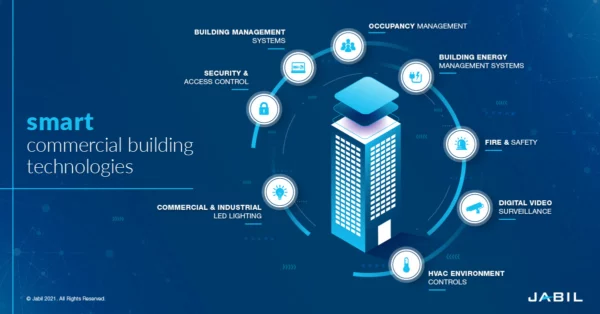
Innovative building technologies give facility managers real-time visibility, automation, and control over critical systems that drive efficiency and reduce operational risk, which is why they’ve gone mainstream fast. Three-quarters (75%) of facility managers now work in IoT-enabled buildings, harnessing technology to optimize efficiency, improve ESG performance, and manage assets proactively.
However, the impact of this tech depends on how you implement it. Identify one or two high-priority systems where real-time data could improve decision-making or reduce operating costs. Consider, for instance, HVAC, lighting, occupancy tracking, or access control.
Prioritize technologies that solve clear operational problems, such as systems that automatically adjust ventilation based on real-time occupancy or software that pinpoints energy spikes tied to specific equipment. Before committing to a full rollout, request a product demonstration to evaluate usability, integration potential, and actual performance.
Lastly, focus on one high-impact area, validate performance improvements, and then build on that foundation where the data justifies it.
4. Prioritize ESG and Sustainability Goals
Translating ESG goals into day-to-day facility operations remains a common challenge, not because the targets aren’t clear, but because systems, teams, and procurement practices often aren’t aligned to support them. Facility managers are in a position to close that gap.
Start by applying established benchmarking systems like LEED, ENERGY STAR, or GRESB as operational guides. LEED’s emphasis on energy use intensity (EUI), water efficiency, indoor environmental quality, and material sourcing can be used to assess current performance and identify gaps.
Tie your ESG metrics directly into the systems your team already uses, whether that’s your BMS, CMMS, or procurement workflow. This makes the data visible where decisions are being made. Use those insights to target practical changes: reduce HVAC load during peak hours, choose lower-impact materials during scheduled works, and shift the frequency of reviews from annual to quarterly.
5. Optimize Space and Asset Utilization
Underutilized spaces and overlooked assets can drain budgets, but with effective tracking and planning, you can do more with less. Over 60% of organizations expect increased workplace utilization in the next five years, so there is a surge in demand for data-driven space planning.
You can start with a simple audit of occupancy data and badge entry logs to compare against utilized space. Even these preliminary insights can often reveal surprising inefficiencies that are easy to fix and unlock immediate value.
To deepen this, link space utilization metrics with HVAC zoning, lighting schedules, and cleaning routines. If certain areas remain vacant, repurpose them for storage, decommission them from daily cleaning, or shut down climate control entirely to reduce energy spend.
6. Leverage Data for Strategic Decision-Making
Facility systems generate constant data streams, from utility meters and work orders to occupancy sensors and equipment logs. But without structure, that information rarely translates into action.
Begin by consolidating and standardizing data and data streams from various systems, from meters to work orders and occupancy sensors. Then, use AI or specialized software to look deeper into key patterns and uncover high-value opportunities like optimizing operational schedules based on actual usage or potential risks, like hidden water pipe leaks. Set a regular cadence for reviewing operational data and ensure insights are shared with the right teams.

7. Enhance Staff Training and Safety Protocols
As buildings become more complex, facility teams need technical know-how and strong digital skills, so continuous development through upskilling and reskilling is critical. In addition, upskilling and reskilling improve job performance and help retain quality personnel, while reducing dependence on third-party service providers.
Work with HR to train a capable, dependable, and tech-savvy team that will bring long-term value to your facility. You can start small with micro-learning modules that equipment manufacturers often provide, introduce mentorship programs, and digitize your OSHA training program.
Proactive Facility Management as an Advantage
Facility management has evolved. It now demands foresight, fast decision-making, and systems that reduce risk while supporting sustainability and performance goals. The most effective teams invest in technology, upskill their people, and embed ESG into day-to-day operations.
Water is becoming a strategic focus. It’s essential for cooling and production in data centers and industrial facilities, but it’s also a major vulnerability when leaks occur. Beyond the risk of damage and downtime, poor water management drives up costs and undermines sustainability efforts.
WINT Water Intelligence gives facility managers full visibility across all water systems — including hot, cold, closed-loop, irrigation, and cooling lines. Its AI-powered monitoring detects anomalies in real time and automatically shuts off flow, even during outages. With centralized monitoring and seamless integration into your FM stack, WINT helps reduce water-related disruptions, cut utility waste by up to 25%, and streamline ESG reporting.
Learn more about how WINT can help you prevent damage, reduce consumption, and meet your sustainability goals.