Wouldn’t it be great if buildings and facilities were self-aware, effectively guiding us on how to take best care of them? While fairytale homes remain a fantasy, the responsibility lies with maintenance managers to design and implement effective facility maintenance strategies.
Fortunately, their efforts don’t go unnoticed. In 2022, the global facility management (FM) market was valued at approximately $42.93 billion. By 2031, it’s projected to nearly triple, climbing to a staggering $120.08 billion.
As a facility maintenance manager, how can you ensure your strategies live up to this market value and adapt to the evolving risks and needs of building managers and owners? Let’s explore what effective facility maintenance management involves and key best practices.

Understanding Facility Maintenance Management: Definition and Impacts
Facility maintenance ensures that a facility building and its equipment are kept in optimal operating condition throughout its lifecycle. It is an umbrella term for a wide range of upkeep tasks aimed at maintaining, optimizing, and supporting buildings’ safety, functionality, and sustainability and their supporting infrastructure.
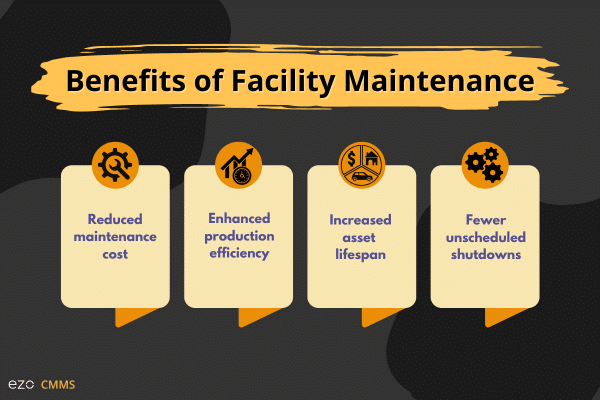
One of the main goals of facility maintenance management is lowering risk and reducing likelihood and duration of unscheduled downtime. That applies regardless of the type of structure, whether the facility is a healthcare facility, a hotel, or commercial property. As such, it is vital for continuous core business operations and necessary for most enterprises, regardless of size or industry.
Facilities risk deterioration without adequate and modern facility maintenance management strategies and protocols. This deterioration rapidly increases safety hazards to building occupants and assets. In many cases, neglecting to address facility maintenance will cause the repair and restoration costs to rise dramatically. For example, failing to maintain water tanks and pipes properly can result in leaks going unnoticed and causing substantial damage.
[Source: ezo Asset Intelligence, Reimagined]
Common Facility Maintenance Components and Procedures
The range of activities related to facility maintenance management depends highly on the type of facility you maintain. Some key components of facility maintenance management include:
- HVAC systems require regular duct cleaning, filter replacements, and refrigerant refills. When properly maintained, these can serve up to 20 years, making them a cost-effective heating and cooling solution.
- Electricity supply and electrical systems need inspections and repairs, including wiring, lighting fixtures, and outdated appliances that may increase energy consumption.
- Plumbing maintenance entails inspecting and timely repairing incoming and outgoing water pipes, pumps, fixtures, and sewage drainage systems. Addressing leaks as soon as they are discovered is vital, as undetected leaks can become serious emergency water damage issues and sanitation nightmares.
- Fire safety equipment and device maintenance are often legally required for any facility to operate. They encompass regular inspections and service of sprinkler systems, alarms, and other relevant equipment.
- Wear and tear inspections of building components like roofs, windows, and walls are essential to detect and prevent leaks or drafts, keep the interior and exterior of the building attractive to the eye, and ensure that it meets operational standards.
- Automating and enhancing facility management operations includes optimizing and automating systems to reduce operational costs and improve the tenant experience. It also includes choosing, installing, and updating building automation systems, adjusting their sensors, and installing software updates. Examples include AI-driven water usage patterns analytics, such as Wint Water Intelligence, or sensor-activated lighting systems.

[Source: ezo Asset Intelligence, Reimagined]
Types of Facility Maintenance Management
1. Reactive Maintenance
Reactive maintenance addresses breakdowns and failures after they occur, focusing on restoring assets to their operational condition. Typical tasks include unclogging drains, stopping leaks, replacing damaged fixtures, or fixing malfunctioning equipment.
While sometimes inevitable, reactive maintenance is usually inefficient and expensive. Tasks are typically very time-sensitive and require exceptionally rapid response to prevent further damage. You may have to pull staff away from other tasks, pay for overtime, or invest in replacing damaged assets and equipment that would remain in serviceable condition if adequately maintained.
That said, reactive maintenance makes financial and operational sense in some situations. For instance, replacing a lightbulb only when it burns out is far more efficient than routinely inspecting every bulb in a building.
2. Preventive Maintenance
Preventive facility maintenance, occasionally referred to as scheduled maintenance, is a proactive approach to preventing potential breakdowns with assets and equipment. It involves conducting regular assessments, inspections, servicing, and replacing worn-out equipment parts according to a predefined schedule. For example, HVAC units require periodic servicing to operate at optimal capacity, lower electricity consumption, and maintain high air quality in your facility.

[Source: INFRASPEAK]
You typically implement preventative maintenance using a checklist based on industry standards and equipment manufacturer recommendations. This maintenance type helps facility managers anticipate issues and keep operations running smoothly. For example, regular inspection and maintenance of roofs are vital in preventing water damage to commercial and residential buildings.
3. Predictive Maintenance
Predictive maintenance leverages sensors, IoT technology, machine learning, and AI-powered analytics platforms to forecast when systems or equipment may fail. These technologies also allow facility maintenance management to prevent potential failures and prioritize maintenance tasks effectively.
They typically offer automatic alerts and predictive analytics and monitor the health of systems and equipment in real-time. For example, heat and vibration sensors on some types of equipment can alert your teams when a machine needs to be serviced long before it malfunctions.
Instead of guessing the optimal schedule for equipment maintenance, predictive maintenance can ensure it is serviced when needed, not when it’s scheduled or when it breaks. As a result, it is the most cost-effective approach for managing most assets.
Regarding predictive maintenance of water systems, Wint offers an IoT and AI-powered platform for real-time leak alerts, flow tracking, and system diagnostics. When it detects a leak, it automatically shuts off the leaky valve. Such technologies prevent costly water damage and reduce waste, enabling facility managers to meet ambitious ESG goals and reduce insurance premiums.

[Source: OCP Maintenance Solutions]
Best Practices in Facility Maintenance Management
1. Ensure health and safety compliance
Health and safety regulations are instated for a very good reason—they prevent unfortunate accidents (and prevent you from being liable for them). They are more than a legal obligation; they often offer a framework for improving operational efficiency and a basis for an operational facility. Regular inspections and assessments and ensuring everyone knows how to identify potential hazards are vital to lowering compliance risks.
2. Embrace Sustainability
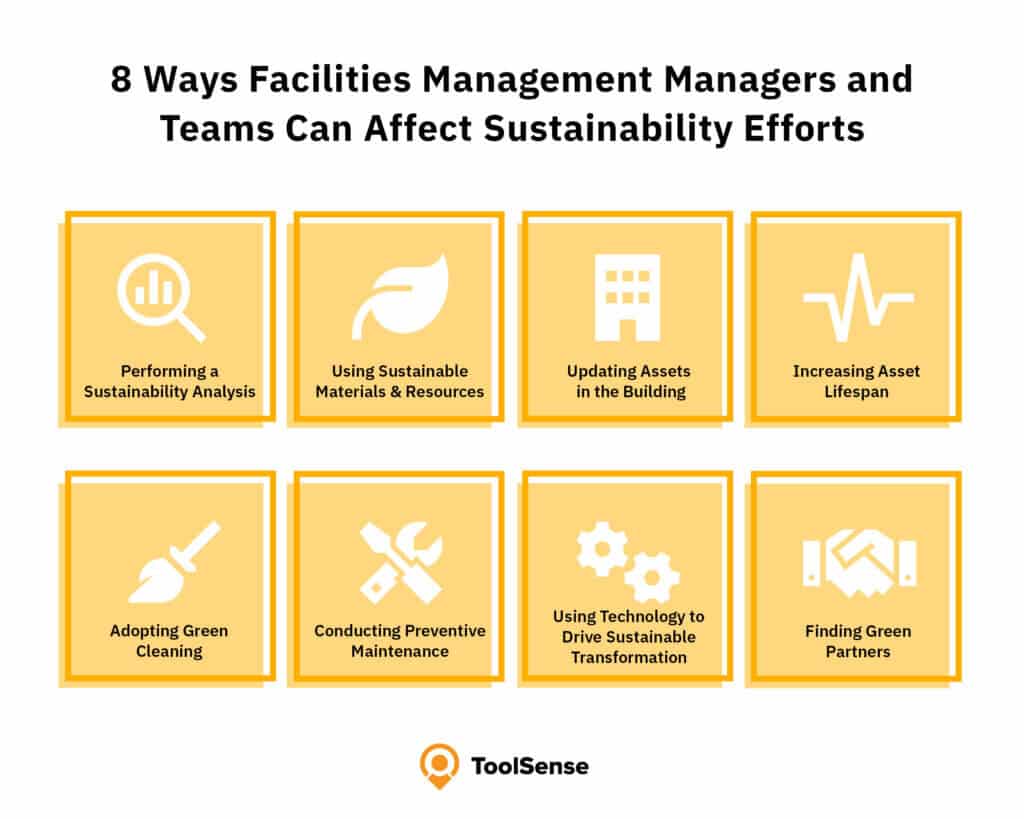
ESG goals and green building certifications are not just good for the planet; they’re also beneficial to your bottom line. Incorporating sustainability into your facility maintenance management strategy can create value by helping lower utility bills, reducing energy consumption, and making your facility more efficient and future-proof.
For facility maintenance managers, this means adopting sustainable practices like eco-friendly materials and smart metering for energy and water efficiency and considering other environmental impacts of maintenance activities, like fuel consumption associated with waste transportation for disposal.
[Source: ToolSense]
3. Establish and communicate clear protocols
Effective facility maintenance management requires efficient stakeholder communication and transparent policies and protocols. Regular meetings ensure your teams are aligned with business priorities and goals. A staff feedback loop can also promote transparency and avoid silos.
Leverage technology solutions to streamline communication, protocol sharing, and issue reporting. To avoid miscommunication, integrate all communication channels—emails, chat apps, and dedicated facility maintenance management software. This way, tasks are executed efficiently and in line with predefined checklists and work plans, expediting maintenance and improving overall coordination.
4. Prioritize proactive facility maintenance
Proactive facility maintenance management strategies effectively reduce costly downtime and emergency repairs. Coupling a data-driven maintenance schedule for all critical assets with tools like Wint Water Intelligence allows you to keep your facility running efficiently. Proactive facility maintenance enables you to:
- Extend your equipment lifespan
- Decrease the need for reactive maintenance
- Enhance facility safety
- Reduce unexpected downtime
- Contribute to resource efficiency and ESG goals
In addition, it empowers your staff to recognize early warning signs of potential equipment malfunction or failure. Whether through regular on-site inspections, sensors, and modern facility management software, your teams can prevent potentially costly or dangerous issues with assets or equipment.

[Source: Xenia]
5. Employ AI to enable data-driven decision-making
Technology is transforming facility maintenance, from autonomous cleaning robots to AI-powered predictive analytics that enhance maintenance efficiency. In 2025, we have many tools to improve occupant experiences and achieve facility business goals.
Before the era of machine learning, AI, and IoT, deciphering data for predictive analytics was a job for data analysts. AI has proven to be a game changer in building management by enabling facility managers to leverage data from various sources, identify patterns and trends, and automate enterprise workflows.
Facility Maintenance Management: What’s Next?
Facility maintenance entails reactive and proactive strategies to ensure top performance at minimal cost. In 2025, this means complying with regulatory requirements, embracing sustainability, and adopting technological solutions. All of which in effort to streamline communications and automate operations proactively. In addition, as the industry continues to go through a digital and ESG-focused transformation, you must stay on top of emerging trends.
Solutions like Wint Water Intelligence are part of a shift to data-driven and AI-based predictive maintenance and the first step toward self-managing facilities. Powered by IoT signal processing and AI data analytics, it helps facilities proactively detect leaks, monitor water flow, and perform water system diagnostics in real-time. Wint not only reduces water waste and prevents costly damage, but also supports facility managers in aligning with sustainability goals and optimizing long-term asset management values.