Most organizations assume that water risk is under control once sensors, alarms, and response procedures are in place. Technically, they should be covered. But in practice, water-related outages and equipment damage still occur, often because issues are identified too late or because alerts lack enough context to drive decisive action.
54% of significant data center outages now exceed $100,000 in total cost, and one in five surpasses $1 million, even in environments with formal monitoring and risk programs in place. The problem is not the lack of systems but having systems that intervene early enough to make a difference.
Electronic leak detection can be a powerful solution for detecting and mitigating water leaks early. There are various types of ELD methods available, so it’s crucial to understand which ones your properties can truly benefit from and how to deploy them effectively.
What Is Electronic Leak Detection?
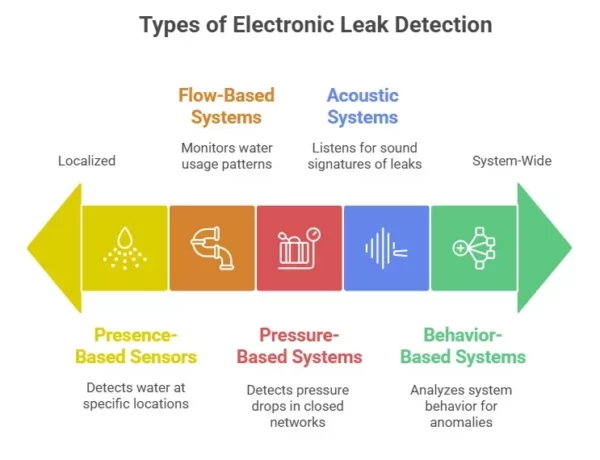
Electronic leak detection (ELD) refers to a range of technology tools that help monitor water flow and detect water leaks in plumbing and distribution systems. These solutions may include physical sensors, connected hardware, or software-driven monitoring platforms. Operating continuously, ELD systems analyze usage patterns in real-time and flag anomalies that indicate potential leaks before they escalate into costly damage.
Water leaks often occur in closed spaces, particularly during periods of low occupancy. Properties may not show any visible damage until the leak has become significantly worse. Without continuous monitoring, water leaks are often discovered too late, after systems or assets have already been affected. Electronic water leak detection equipment is crucial in adopting a more preventive approach and preventing damage.
Note that electronic leak detection is an umbrella term that encompasses several fundamentally different technologies and approaches. Each detects water risk in a specific way, and they vary widely based on what they monitor, how early they detect issues, and how actionable their outputs are.
Due to these differences, not all ELD deployments provide the same level of protection. Understanding the types of electronic leak detection in use is crucial for evaluating coverage, gaps, and the actual operational value.
Types of Electronic Leak Detection
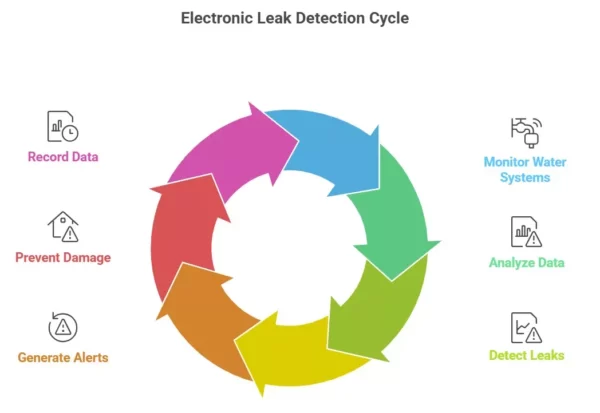
Electronic leak detection solutions measure various parameters, including the presence of water, flow rate, pressure, sound, and system behavior. They also identify risks in different ways. Here are some common types:
- Point Leak Detection (Presence-Based Sensors): These systems use moisture or conductivity sensors placed at specific locations. They trigger an alert when water physically comes into contact with the sensor. They are basic and widespread, but may not offer instant detection like other solutions do.
- Flow-Based Leak Detection: Flow-based systems monitor water usage over time and compare it against expected patterns. Its effectiveness depends on the system’s ability to distinguish operational variability from true anomalies.
- Pressure-Based Leak Detection: Pressure sensors detect drops or fluctuations that may indicate a breach in a pressurized system. These systems are invaluable in closed networks but can be less effective in environments where pressure changes are frequent or demand is variable.
- Acoustic Leak Detection: Acoustic systems listen for sound signatures associated with escaping water, often through vibration or noise analysis. They are commonly used in underground or inaccessible piping, but can be sensitive to background noise and environmental conditions.
- System-Level, Behavior-Based Leak Detection: This approach analyzes water behavior across entire systems rather than isolated points. By monitoring patterns, trends, and deviations, it can identify abnormal behavior before a visible leak occurs, making it well-suited to complex environments.
Although many electronic leak detection platforms include software and analytics layers, they are fundamentally OT assets (physical assets), as they interface directly with physical water infrastructure rather than traditional IT environments.
Key Use Cases for Electronic Leak Detection
1. Main Water Supply and Distribution Monitoring
The most universal application of electronic leak detection is monitoring the main water supply and internal distribution networks. Any building with a centralized supply benefits from knowing when overall consumption deviates from expected patterns.
In this scenario, you would deploy flow-based electronic leak detection at incoming mains, risers, and major branches to measure water movement across the distribution network. By establishing standard consumption patterns, the system can identify deviations that indicate leaks, unauthorized usage, or system faults.
In more advanced deployments, teams utilize behavior-based analysis to distinguish between abnormal conditions and legitimate operational demands. These enhance detection accuracy in mission-critical environments, such as data centers and healthcare facilities. This use case applies across commercial buildings, residential complexes, industrial facilities, campuses, and mixed-use properties.
2. Mechanical, Cooling, and Process Water Systems
Mechanical and cooling systems are consistently high-risk. These systems operate continuously, often under pressure, and are tightly linked to operational performance. Failures frequently begin as minor control issues (such as stuck valves, degraded seals, or imbalance in flow rates). Because volumes are high and systems are interconnected, even minor anomalies can escalate quickly due to sustained operation and proximity to critical assets.
Since cooling disruptions can directly impact uptime, electronic leak detection here focuses on early intervention during abnormal system behavior. Flow-based and pressure-based electronic leak detection are commonly deployed across chilled water loops, cooling towers, smart manufacturing lines, and large mechanical plant rooms.
3. High-Risk Spaces and Asset-Dense Areas
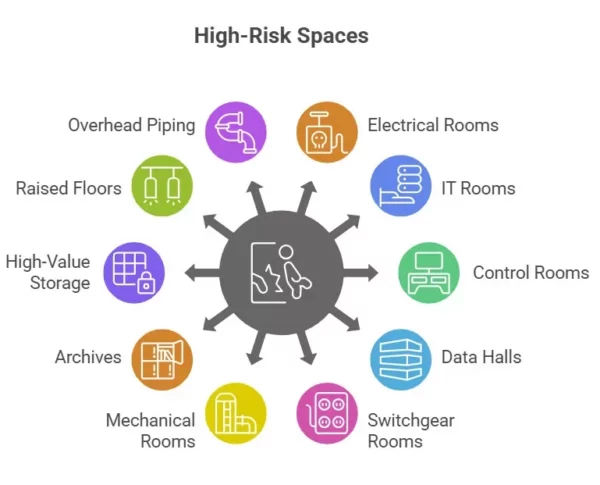
Electrical rooms, IT and communications spaces, control rooms, and other asset-dense areas typically contain sensitive equipment, including switchgear, uninterruptible power supplies (UPS), power distribution units (PDUs), server racks, network cabinets, and building management controllers. Exposure to moisture in these environments can lead to immediate equipment failure, safety hazards, and prolonged downtime.
These areas typically employ a combination of point-based leak sensors placed beneath raised floors, around equipment skids, and near known failure points. They also use upstream flow monitoring to enable automatic water leak detection based on abnormal usage patterns. The goal is to reduce time-to-detection to minutes, not hours, and allow rapid intervention (manual or automated) before water reaches energized or mission-critical equipment.
This use case also applies to archives, high-value storage areas, and spaces with overhead piping or limited drainage, where leaks from chilled water lines, domestic supply piping, or fire suppression systems may remain concealed above ceilings or behind walls.
4. Unoccupied or Remote Properties
Facilities that are unoccupied overnight, intermittently staffed, seasonally closed, or geographically remote are particularly vulnerable because leaks can persist for hours or days before anyone notices.
Electronic leak detection provides continuous, system-level oversight across domestic supply lines, irrigation systems, mechanical rooms, and tenant spaces during nights, weekends, holidays, and shutdown periods. It detects anomalies in real-time and routes alerts to centralized operations or facilities teams.
For organizations managing distributed portfolios, such as commercial real estate, hospitality, education, industrial sites, or infrastructure assets without 24/7 staffing, ELD is a key risk-control mechanism that ensures consistent visibility.
5. Construction, Renovation, and Transitional Phases
Construction and renovation phases create a temporary risk profile that does not exist during steady-state operations. Water systems are frequently modified, isolated, or reconnected; teams introduce temporary feeds and bypasses; pressure conditions change; and responsibility for system integrity is often shared across multiple contractors and trades. These conditions make leaks more likely and more challenging to attribute when they occur.
Electronic leak detection validates water behavior during these changes. It monitors temporary connections, phased tie-ins, pressure testing periods, and newly commissioned zones to confirm that flows align with expected construction activity. Abnormal usage outside approved work windows, unexpected overnight flow, or post-commissioning anomalies can be flagged immediately, reducing the risk that a construction-related issue propagates into occupied or operational areas.
Additionally, when electronic leak detection data is integrated with construction document management software, project teams gain clearer visibility into approved drawings, change orders, commissioning records, and work windows.
6. Multi-Building Portfolios and Centralized Operations
Different buildings may be operating under varying assumptions and have different response thresholds and levels of oversight. These inconsistencies in multi-building portfolios make it difficult for central teams to compare performance, enforce standards, or understand where risk is actually concentrated.
Electronic leak detection functions as a portfolio control layer. ELD standardizes the measurement of water behavior, defines anomalies, and escalates incidents across campuses, regions, or distributed asset portfolios. Central operations teams gain a normalized view of water usage and events, allowing them to identify outliers, recurring issues, and systemic weaknesses that would be invisible when you manage sites independently.
7. Ownership, Liability, and Insurance Exposure
Many ELD deployments are driven by financial liability rather than technology preference. For example, when owners retain responsibility for water damage regardless of fault, when lease structures limit tenant liability, or when insurers impose explicit loss-prevention requirements following prior claims.
In this case, ELD establishes an objective record of water system behavior, timestamps the onset and duration of abnormal events, and documents when alerts were generated and how quickly action was taken. This level of traceability is crucial during claims investigations, subrogation disputes, and insurer audits, where leaders need to demonstrate early detection.
For organizations with increased deductibles, conditional coverage, or a history of water-related losses, ELD is critical to risk containment.
The Operational and Financial Value of Electronic Leak Detection
In mission-critical environments, the primary value of electronic leak detection is preventing downtime. Early identification of abnormal conditions allows teams to intervene before issues escalate into service-impacting events.
Operationally, this results in fewer emergency repairs, reduced unplanned maintenance, and increased confidence in system behavior. Teams gain visibility into risks that do not trigger traditional alarms, enabling more controlled responses.
From a governance perspective, ELD strengthens compliance, audit readiness, and insurance reporting by delivering objective, time-stamped data. Over time, this enables measurable reductions in loss frequency, supporting a more proactive risk posture.
AI-powered enterprise water management systems, such as WINT Water Intelligence, enhance ELD by distinguishing between expected operational activity and actual signs of malfunction, even in complex, high-variability environments. They reduce false alarms that lead to alert fatigue and enable early identification of patterns that signal emerging failures, not just active leaks.
WINT’s use of signal processing and data analytics also provides historical context for root-cause analysis, drives consistency in detection standards across sites, and empowers maintenance and risk teams to make more informed, data-backed decisions.
From Detection to Operational Resilience
Leaders need reliable leak detection everywhere, but in mission-critical environments like live data centers, it’s non-negotiable. With temporary systems, unpredictable flow, and complex infrastructure, even a minor leak can bring operations to a halt. That’s why early electronic detection is crucial to maintaining smooth operations.
Water management solutions like WINT are specifically designed for high-risk environments. WINT leverages AI and data analysis to continuously monitor all water systems and detect anomalies early, allowing for the automated or remote shutoff of leaky valves. Plus, its autonomous edge devices remain operational during network or power disruptions, enabling proactive water risk management without adding operational complexity.
Treating electronic leak detection as a core operational control supports stronger uptime protection, reduced exposure, and more transparent operational accountability. Contact our expert team to discover how you can identify water risks earlier and maintain uptime across mission-critical environments.