Environmental accountability is deeply embedded in the built environment, and leaders aren’t afraid of setting ambitious sustainability goals. What differentiates leaders is not the scale of their commitments, but their ability to prove that those commitments translate into real, ongoing performance once buildings are in use.
70% of construction projects now incorporate sustainability targets, and 53% of companies adopted carbon offsetting strategies in 2024, up from just 38% in 2021. Translating those ambitions from theory into operational reality depends on green building technologies, including energy and water systems, automation, materials, and on-site renewables.
Understanding which technologies matter most, and how they work together in live environments, is essential for anyone responsible for performance, risk, and ESG disclosure.
What Are Green Building Technologies?
Green buildings are infrastructures optimized to reduce environmental impact while improving efficiency, resilience, and occupant well-being across their lifecycle. Green building technologies are the systems and platforms that make this possible in practice, enabling buildings to manage resources actively.
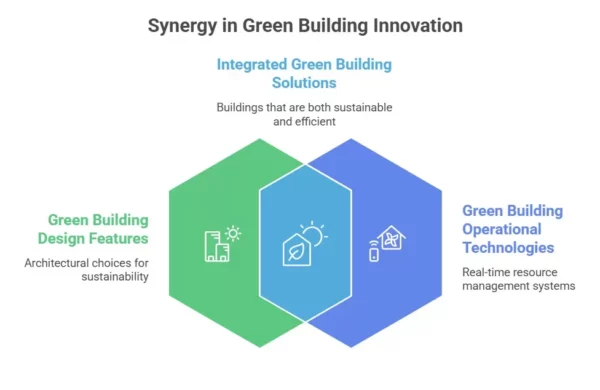
It is essential to distinguish between design features and operational technologies. Design features include architectural decisions such as orientation, insulation, glazing, and material selection. Operational technologies, by contrast, govern how a building performs day after day. These systems measure, optimize, automate, and adapt performance in real time, ensuring sustainability once the building is occupied.
Green building technologies span several interconnected domains. For example, energy management systems regulate power consumption and distribution, while water technologies monitor usage, detect losses, and protect critical infrastructure. Automation and AI platforms unify these data streams to deliver continuous performance improvement.
Why Investing in Green Building Technologies Is a Non-Negotiable
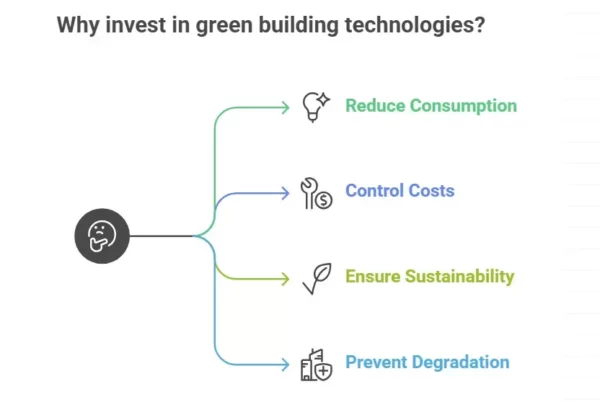
1. Measurable Reduction in Energy, Water, and Resource Consumption
Green building technologies actively control how building systems operate in real time. Continuous monitoring enables systems to respond to actual demand, eliminate waste, and correct inefficient operating states as they occur. Generative AI in construction can support this process upstream by informing early-stage design and scenario modeling. However, measurable reductions are ultimately delivered through operational control once buildings are in use.
2. Operational Cost Control
Buildings equipped with AI-powered energy, water, and automation systems experience lower utility costs, reduced emergency repairs, and more predictable maintenance spend over time. By identifying issues early and optimizing system behavior, organizations gain greater control over lifecycle costs. You can then allocate spending to planned, condition-based maintenance, improving budget predictability.
3. Verifiable, Audit-Ready Sustainability Performance
Regulators, investors, and assurance providers increasingly expect traceable data that connects sustainability claims to operational evidence. Green building technologies provide the continuous, system-level data needed to support disclosures that stand up to scrutiny. Because this data is generated directly from building systems rather than manual estimates, it reduces reliance on assumptions and improves consistency across sites and reporting periods.
4. Preventing Performance Degradation
Buildings often fail to meet sustainability targets not because of poor design, but because systems drift, teams may unknowingly override controls, or miss inefficiencies. These technologies preserve performance integrity over time by detecting deviations early and correcting them before they become embedded in daily operation.
Ultimately, buildings that deploy proven green technologies demonstrate greater resilience. They adapt better to regulatory change, energy volatility, water risk, and operational disruption, positioning organizations for long-term competitiveness rather than short-term compliance.
6 Green Building Technologies You Need to Know by Category
The following categories reflect the main areas where green building technologies influence real-world performance. Within each category, different technologies address specific operational challenges, from measurement and control to automation and long-term efficiency.
1. Energy Efficiency & Intelligent Power Management
Energy systems remain foundational to building sustainability, but their effectiveness depends on continuous visibility and control. Advanced energy management systems function as centralized intelligence layers for power consumption. These platforms monitor energy use across HVAC, lighting, equipment, and on-site generation in real time, analyzing patterns and identifying inefficiencies as they emerge.
Instead of relying on modeled assumptions, they deliver measurable, operational savings and are particularly effective in large commercial buildings, campuses, and industrial facilities where energy complexity is high.
Within this category, there are also advanced lighting systems that combine LED technology with occupancy sensing and daylight harvesting to reduce unnecessary energy use. These systems automatically adapt lighting levels based on how occupants use the spaces, significantly lowering energy demand while improving operational control. They are especially effective in offices, warehouses, and mixed-use developments where usage patterns fluctuate throughout the day.
2. Smart Water Management & Leak Detection
Water is one of the least reliably measured resources in commercial buildings, despite its growing importance under ESG frameworks and risk management programs.
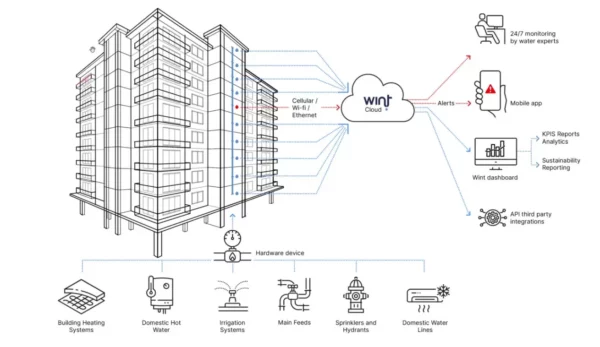
AI-powered water monitoring platforms provide continuous visibility into water consumption across all building systems. By analyzing flow behavior in real time, these platforms identify anomalies, inefficiencies, and hidden losses that traditional meters miss. The result is accurate, site-level water performance data that supports both operational decisions and sustainability reporting.
Automated leak detection and shutoff systems take this a step further by identifying leaks at their earliest stages and automatically stopping water loss. Unlike sensor-heavy approaches that rely on dozens of point devices and often generate false alarms, WINT uses an in-line architecture combined with real-time analytics and advanced signal processing to detect and stop leaks at the source. The system monitors all water lines continuously, without retrofitting buildings with extensive sensor networks, making it highly scalable across portfolios.
WINT supports CSRD requirements and LEED and BREEAM water efficiency credits while delivering measurable reductions in water waste and operational risk.
3. Sustainable Building Materials & Low-Carbon Construction
As operational emissions from buildings decline, an increasing share of an organization’s remaining carbon footprint comes from Scope 3 emissions associated with construction materials and supply chains. These emissions, generated by the production and transport of materials such as concrete and steel, are fixed mainly before a building is occupied.
Low-carbon concrete and alternative cement technologies reduce emissions at this stage without changing structural performance. They are critical in large developments where leaders need to reduce and report embodied carbon needs at the asset level.
Lifecycle assessment and embodied carbon software enable teams to quantify these impacts during design and procurement. By making material-related emissions comparable and traceable, these tools support more credible reporting and better-informed building decisions.
As organizations rely more on supplier-provided data for embodied carbon reporting, vendor risk management becomes increasingly important to ensure that material disclosures are reliable, auditable, and consistent across projects.
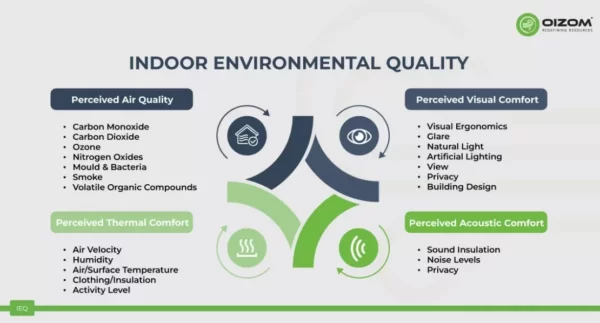
4. Indoor Environmental Quality Technologies
In high-performing buildings, indoor environmental quality (IEQ) is an operational variable that directly affects occupant productivity, system efficiency, and long-term asset performance.
Indoor air quality monitoring systems provide continuous visibility into conditions such as carbon dioxide levels, particulates, and pollutants that fluctuate throughout the day. These systems show how real occupancy and system behavior affect indoor conditions, supporting healthier environments and providing evidence for workplace and wellness standards.
Smart HVAC and ventilation controls act on this data in real time. These systems adjust airflow, temperature, and humidity in response to actual demand, preventing over-ventilation during low occupancy and under-ventilation during peak use. This is particularly important in offices, healthcare facilities, and educational buildings where usage patterns change constantly.
By linking environmental conditions to live operational data, IEQ technologies help buildings maintain consistent indoor performance while avoiding unnecessary energy use.
5. Automation, AI & Predictive Building Intelligence
As building systems become more complex, performance failures rarely show up as single, obvious faults. Often, they emerge gradually through conflicting control logic, persistent overrides, sensor drift, or small inefficiencies that compound over time. Automation and AI address this gap by continuously evaluating how systems actually behave in operation, rather than how they were designed to perform.
AI-driven fault-detection and diagnostics platforms surface these hidden issues by comparing live operational data with expected performance patterns. This allows teams to identify problems that traditional alarms and periodic inspections miss, such as simultaneous heating and cooling, miscalibrated sensors, or equipment running outside optimal ranges. Left unresolved, these conditions quietly drive energy waste and accelerate asset degradation.
Predictive maintenance platforms shift maintenance decisions away from fixed schedules and toward the equipment’s actual condition. By analyzing historical and real-time data, they indicate when intervention is genuinely required, reducing unnecessary service activity while lowering the risk of unplanned failure. In environments where uptime matters, this changes maintenance from a reactive cost center into a controlled operational function.
6. Renewable Energy Integration & Storage
On-site renewables reduce operational emissions only when they are integrated into how a building actually consumes and manages energy.
Solar photovoltaic systems remain the most widely deployed on-site renewable technology, but their value extends beyond generation alone. When paired with intelligent monitoring, PV systems provide predictable, time-stamped data on energy production, allowing organizations to quantify emissions reductions and understand how renewable output aligns with building demand.
Battery energy storage systems address the mismatch between when renewable energy is generated and when it is needed. By storing excess generation and releasing it during peak demand periods, storage supports load shifting, reduces grid dependence, and improves resilience during supply disruptions.
As these platforms become more connected and software-driven, operational resilience also depends on security assurance practices such as white-box penetration testing, typically conducted by specialized OT or IoT security teams to identify vulnerabilities that could disrupt building operations.
Making Green Building Performance Credible at Scale
Buildings become greener not simply through sustainable materials or efficient equipment, but through integrated, intelligent systems that perform reliably under real operating conditions. While energy performance is often well monitored, water remains a reporting blind spot for many organizations, despite its direct link to operational risk, carbon emissions, and regulatory exposure. Without continuous, accurate measurement, sustainability claims around water are difficult to substantiate.
WINT’s AI-powered platform monitors all water lines, from mains to cooling systems, using real-time analytics and advanced signal processing. The system detects waste, identifies inefficiencies, and can automatically shut off water when leaks occur. Organizations using WINT typically reduce water consumption by 20-25%, support LEED and BREEAM certifications, and cut carbon emissions associated with water heating and delivery.
Unlike sensor-based tools, this platform delivers enterprise-grade performance without false alerts, enabling sustainability, operations, and ESG teams to rely on the data with confidence. If your organization is under pressure to deliver credible, audit-ready sustainability performance across a building portfolio, it is time to focus on systems that perform.
Contact our expert team to see how WINT helps transform water from an ESG risk into a measurable sustainability asset.